


Software used to scale processes. Now it scales culture. And as AI reshapes what’s possible every few months, organizations will have to keep pivoting without breaking the culture that holds them together. The way a team decides, learns and changes direction can now be built into the systems they work with. The leaders who can do that are Pivot owners, and this is their era.
Trillions of dollar’s worth of software has been developed over the last decade and it has powered some of the most ambitious outcomes in history. And there have been leaders and people who saw it through.
But the opportunities that are opening up with scaling culture at scale are unprecedented and it’s going to require new kinds of engineers and new kinds of leaders.
The ladder of roles
When the software industry was blooming, first there were project managers, and then there were people managers, and then there were product managers. Each of the previous roles superseded the earlier. There was an era, where great project managers determined the speed, throughput and market relevance, and it rapidly evolved to a space where a leader could do all that a project manager did, lead leaders and had a deep understanding of the product and user experience and they came to become product owners.
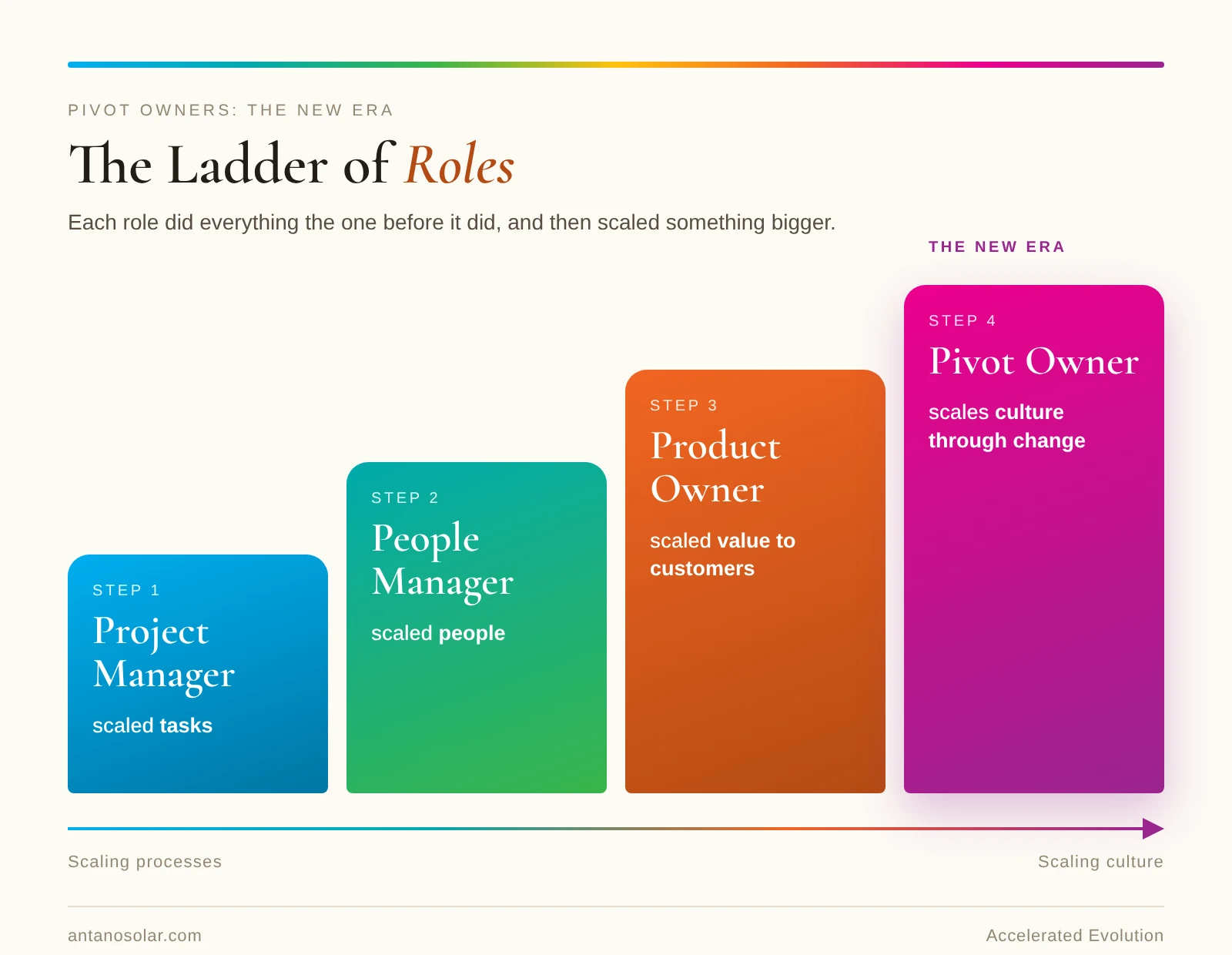
- Project managers are people who can understand the 10 things that need to be done and do them well. They think about what the exceptions will be and who the resources are.
- People Managers came next. They led a large pool of project managers and made sure the right people were on the right problems, that teams stayed aligned with each other, and that talent kept growing as the work grew. They hired, coached, settled the tug-of-war between priorities, and turned the company’s direction into what each team did on Monday morning. They go by different names in organizations today: some are called Senior Directors, some VPs of Engineering, some Heads of Delivery. Their leverage was people. A great People Manager could make a hundred engineers move like one team. They were also the first leaders who carried culture across teams.
- Product Owners are people who can do all of that and also know what the business and the customers need. In many companies this could be the CEO, like in the case of Apple (in spirit), or someone who is responsible for growth hacking a vertical. This has been a very powerful role especially in organizations where the middle level management doesn’t exist, and the Product Owner has full decision-making autonomy over what gets built. Many former product heads became CEOs like Sundar Pichai at Google and Neal Mohan at YouTube.
The era of Pivot owners
Now, in this New Era we can expect a new level above all three. This is the era of Pivot owners. People who read where the world is moving and get the culture of the organization ready to move there.
What a pivot really is
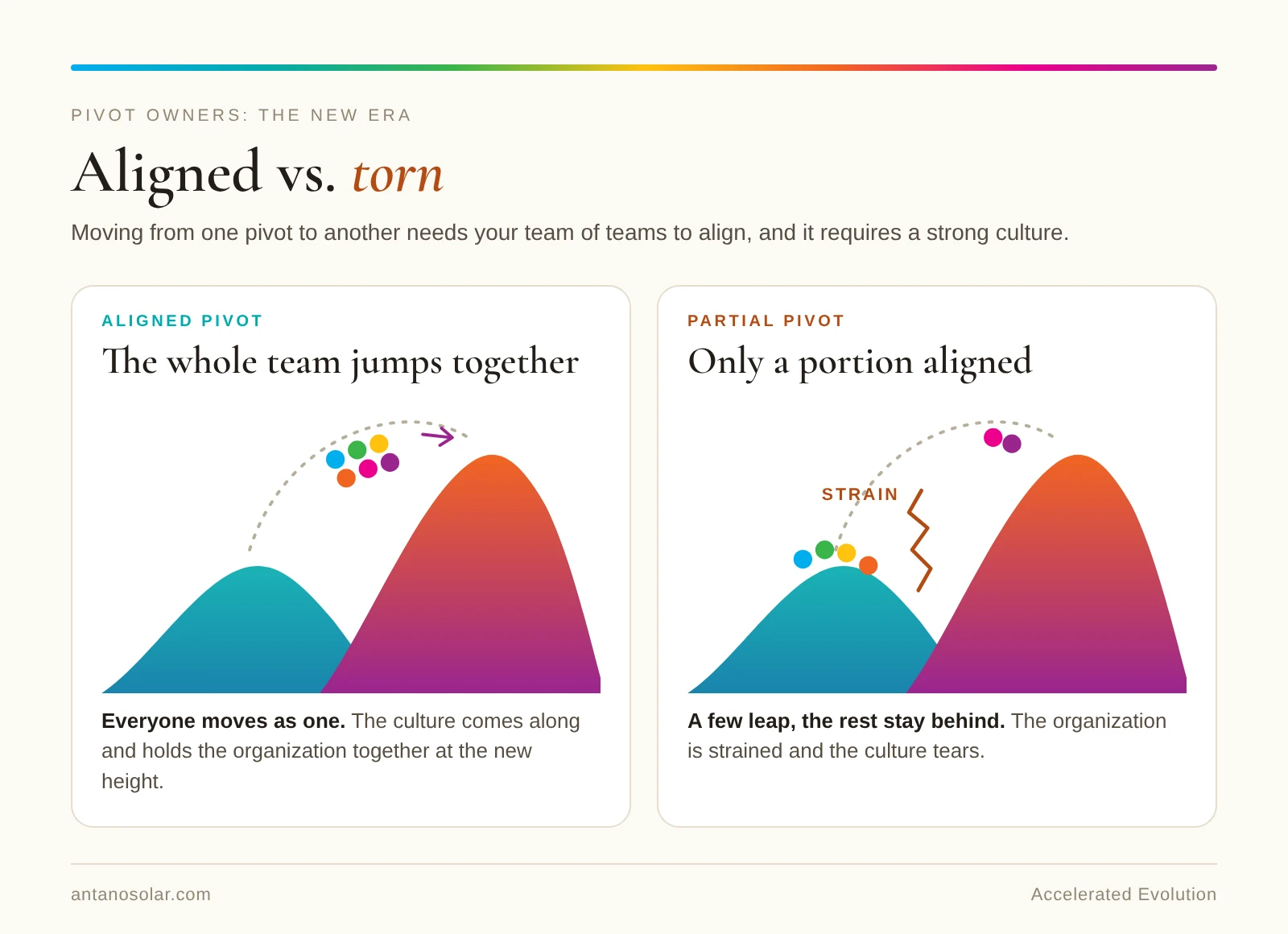
A Pivot for an organization is more than jumping from one level to another level. Imagine you’re standing on a hill. And that hill has a peak, you may get to the peak slowly or fast, but when you get there, that is the limit of that hill. But, there is a hill nearby, that reaches much higher to the skies and greater height. And you can jump from this hill to that other hill. And that is called a Pivot. And pivoting may feel easier now than ever before but it also comes with a risk.
Just like jumping between one hill to another is risky, moving from one pivot to another needs your team of teams to align and requires a strong culture. And it calls for judgement, and leadership and capability because when not done carefully, a pivot with just a portion of the team aligned can create an organization strain, and a torn culture.
Why organizations have to keep pivoting
Teams may not be able to understand or align to the new direction a small group or the leaders of the pivot are getting to. And at the same time, given the rate and scale at which AI is evolving, organizations have to pivot.
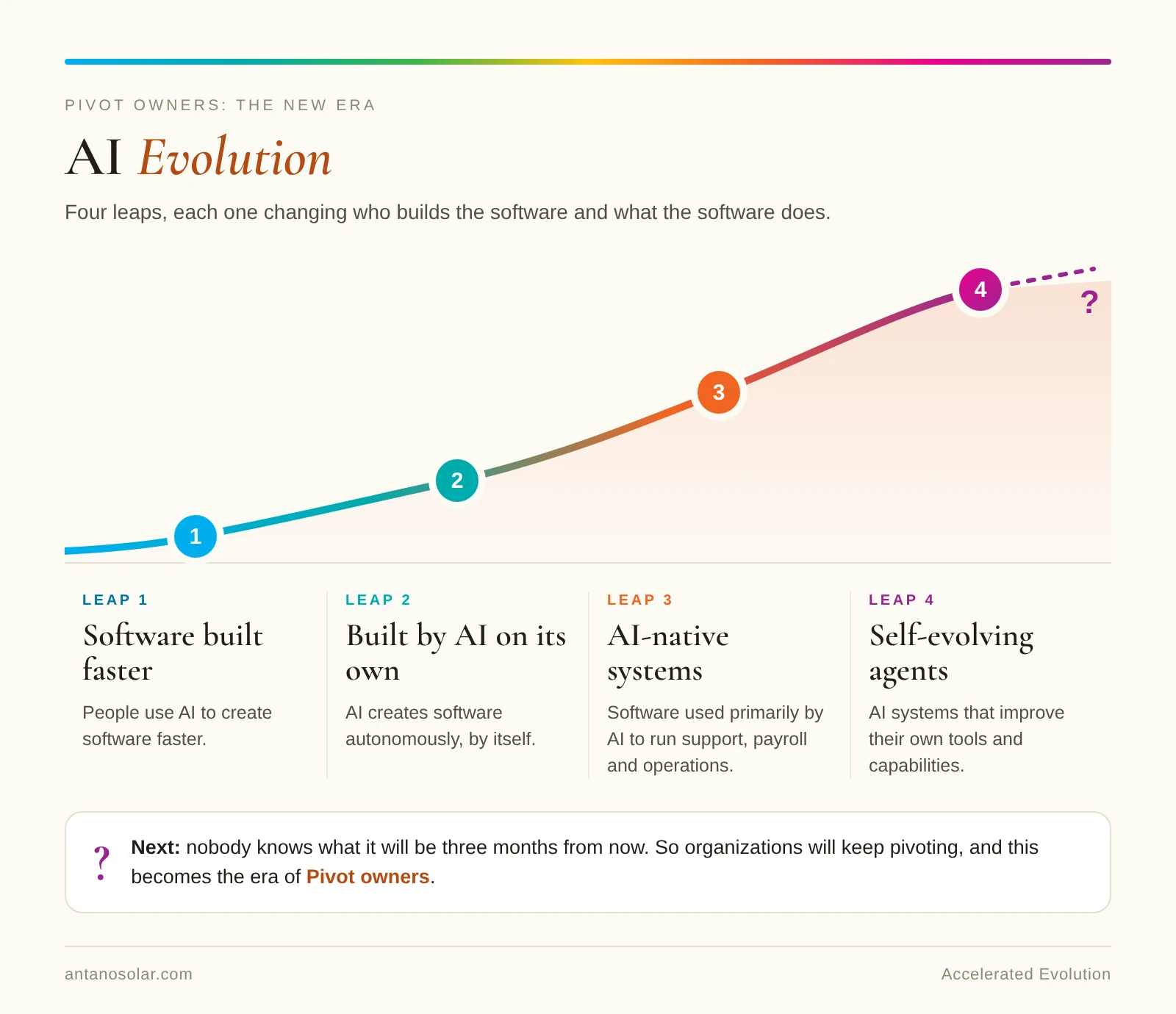
When AI became accessible to the general population, people were thinking about how to create software faster. Then they used AI to create software autonomously by itself. Then we moved to build the software systems that are primarily used by AI itself to provide customer support, payroll, run operations – known as AI-native. Then we levelled up to integrate the business process, AI led software development, and many such things to create self-evolving agents.
These are AI systems that improve their tools, capabilities by themselves. And bring to the organization the speed and discovery of opportunities at an unprecedented rate.
Now we don’t know what it’ll be 3 months from now, so organizations are going to keep pivoting. That makes this an era for Pivot owners.
Ready, not just capable
Pivoting does not mean dropping everything. What you carry across the jump matters as much as where you land. You still need the core things: Engineering, Creativity, Design, and the human expertise to understand culture and user experience.
The Pivot owner is able to build and evolve high-performance teams, and knows that culture is a complex, integrated system of interdependent humans interacting in pursuit of the impact they want to make together as an organization.
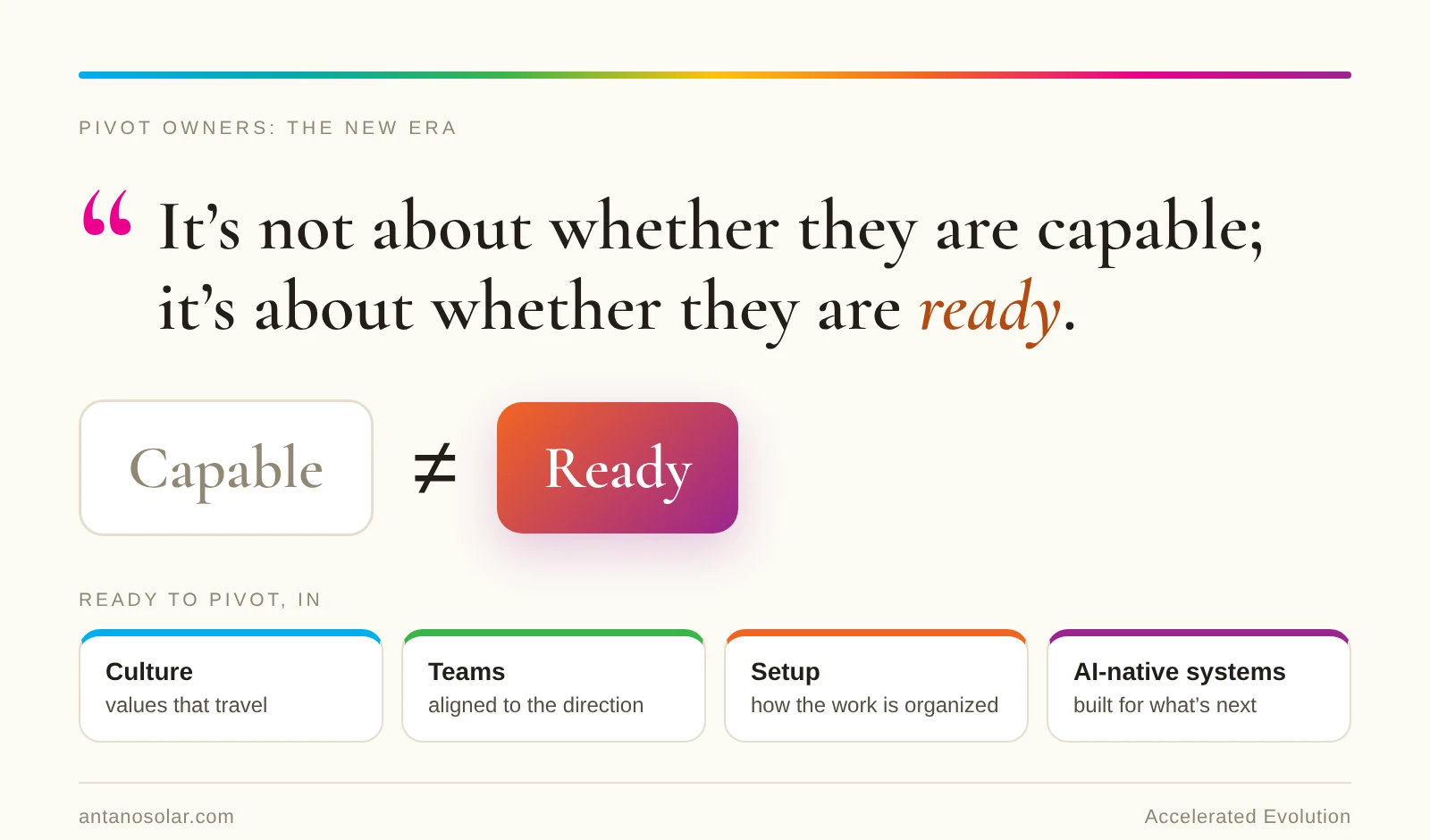
Culture is a system of interconnected human beings with different functions, different values and distributed goals. A Pivot owner is sensitive to the core values, leadership and where the world is moving, and how ready the organization’s culture is to grab them, because it’s not about whether they are capable; it’s about whether they are ready, in culture, teams, setup and AI native systems to pivot there. They see the opportunities before the organization is ever ready to notice them by itself. Today, Pivot owners may not pivot from one hill to a higher peak, but maybe even to the moon and beyond. They think about it from growth, where the industry is moving and the future of the organization and the people who make all this.

The new era is going to be for such Pivot owners.
Running the pivot on ourselves
We’re not writing this from the outside. We’ve been running this pivot on ourselves.
As Evolution Scientists, we have done just this with Accelerated Evolution, our way of compressing the years it takes to grow a capability. We took decades of expertise and our research to facilitate the creation of such Pivot owners at scale. This is a fully drawn out journey of 12 Months, and we are right 4 months into it. A key product for bringing Accelerated Evolution to more people is Solar Voice.
An AI powered app that helps people develop capabilities as they listen and go to sleep. In our earlier measurement of the tracks, before the AI layer existed, listeners reported sleeping deeper and waking up with clarity. It is built on decades of our insights and on an audio product that has been listened to for 26,000 hours since 2023. The gap it bridges is strategic, just-in-time capability development, simply by going through the experience. Simply chat, and the AI will assemble a listening experience and the rest is magic.
The interesting part is how we developed the entire software. It runs on autonomous loops that understand the core science of what we do. But at the same time, respects the science and involves the Evolution Scientists where data training is required. Involves the product owners to discuss features. And all of the management tools to track telemetry, run iteration rounds, ship builds on every change, and A/B test the product with cohorts are all custom built. We are in a new era, where the self evolving AI systems have so much context, that with good engineering, you can build your hand in glove work culture. And facilitate that adoption by building joyful user experiences for the entire team that is working on the pivot.
Private by design
Moving this fast never meant cutting corners on trust. Solar Voice is private by design: it runs as a closed release, and every new person is approved by us while we build it to India’s new data protection law, the DPDP Act, before it opens to the public. The conversations people have with it are personal, so privacy is part of the culture we’re building now.
In 17 days, across seven demo days, we made 15 course corrections, about two per demo day, without tearing the culture.
A quick look into how we build Solar Voice.
From 27 October to 12 November the app went in front of people on seven demo days, and the product changed course fifteen times — about two corrections per demo day, each decided by the founders and written up as it happened. The culture absorbs the small turns, so the big leap stays possible.
Returning between demos: 26 Oct (2), 3 Nov (1), 4 Nov (7), 6 Nov (1), 11 Nov (1). Forms = Experience Forms submitted. The 15 course corrections are listed below.
- 127 OctPersonalisation goes one level deeper: from the person to the moment
- 228 OctA new way of reading the science goes live
- 329 OctThat method refined again after its first results
- 430 OctThe first screen felt like a menu → people now begin in their own words
- 531 OctNo way to tell whether a session helped → discovery of a secret sauce
- 63 NovChoices were hard to trace → every choice now explainable
- 73 Nov“Feeling better now” separated from “growing over time”
- 83 NovA clearer way to begin a session
- 95 NovPeople felt rushed into a session → they choose now, later, or keep talking
- 105 NovThe insight crowded the conversation → it now arrives when it lands best
- 115 NovA faster selection step, switched on safely behind a control
- 126 NovA smaller, easier first commitment
- 137 NovInsights were losing their depth → they now land with full precision
- 1410 NovA live pilot with a small named group
- 1512 NovThe newest method added alongside what already works, not instead of it
What it takes for the software to keep up with a direction that changes twice a demo day.
Most of the build isn’t the app. It’s the custom tooling that lets agents and people work as one team, and that carries the science into what the agents do.
People generate the signal; agents turn it into builds; people decide at the gates where judgment is needed.
Commits to the main build since August. November is 13 days in, already past August, and on pace to be the busiest month yet.
November: 278 commits in 1–13 Nov, on pace for ~640 (the striped bar shows the projected month at its current pace).
Counted 13 November 2026 from the project’s version history and its live usage records. Demo participants: distinct demo accounts that sent at least one message in the demo window (engineering test accounts excluded). Experience Forms: the public before-and-after form. Course corrections: direction changes the founders decided from 27 October to 12 November, each recorded on the day; demo days are the days forms came in. “Co-written with AI” counts commits recorded as co-authored by an AI agent. Evaluations: saved outputs of the simulation, replay and testing harnesses, counted 13 November 2026; a lower bound. Tokens: AI tokens processed by the building agents on the build machine, 1–13 November; a lower bound.


